The Art of Renunciation and Spiritual Living
The days and nights are relentlessly passing; How well am I spending my time?
— Aṅguttara Nikāya 10.87
Yesterday, I said a goodbye-for-now to Harideva (HD) and Niseema, two of some of the most interesting people I've ever known. They're moving back to India once again, with little certainty about what's next. One of them growing up in the rough, gang-ridden streets of Boston, and the other in rural Oklahoma raised in the Pentecostal church in a backdrop of poverty and addiction, both of them left everything behind and became sannyasins in the Rajneeshee movement. I've witnessed the pair go through intense moments, individual and shared phases of drug use, alcoholism, violence, emotional breakdowns, and more. They've lived in all types of environments, from the slums of India to the New Age communities in Germany. These two are tough and gritty, take no shit, and live on the edge of life. And somehow, they find a way to keep persevering and healing, despite the great darkness they've been through. Then, in some moments, they have moments where they'll burst out in spiritual fervor, sharing profound wisdom and insight.
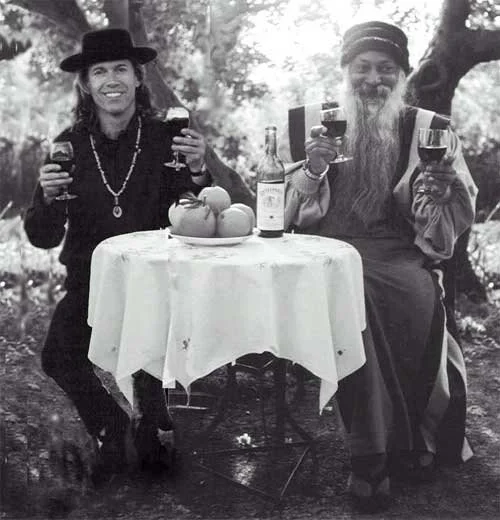
HD with Rajneesh (later known as Osho) sometime in the 70s
Last night, I vocalized my sense of awe in witnessing them evolve and heal over the years. Niseema had called themselves renunciates: people who extricate themselves from material possessions and attachments and desires for pleasure, comfort, and control. Renunciates accept, without prejudice, whatever life gives them. HD remembered Osho talking about renunciation. Osho had shared that many claim to be renunciates in a way that's similar to forcefully pulling a fruit off a tree that's not ripe. In the grasping for spiritual enlightenment and truth, we endlessly chase after sweet fruits, the next escape, the next sacred medicine journey. It is nothing more than greed for enlightenment, spiritual bypassing. Yet true renunciates know the power of allowing the fruits to ripen, so that it drops right into their hands. So how does one live their life in ways that allow for the natural ripening of life, and its gifts and teachings?
Renunciation is not a matter of doing something or having to create something, or getting rid of something or exterminating something in life. Rather it is moving towards non-contention, a sense of rest and relaxation—not having constantly to try and manipulate and control and evade and maneuver any more. We are able to open and relax into the experience of the moment, whatever its quality may be. In opening to receive life, we still engage in the conventional level of reality—the social level of moral values, identities, mother and father, livelihood and mortgages. If we grasp these things and expect complete fulfillment from them, we will always be disappointed. But if we see our life as an opportunity to understand Dhamma (the way things are) —that is renunciation. This letting go is very freeing. Whatever comes to us is Dhamma, and there is a joy in being in contact with Truth, whatever its particular flavor.
- Sister Siripaññā, Renunciation: The Highest Happiness
According to Theravāda Buddhist teachings outlined in the Pāli Canon scriptures, Sister Siripaññā explores the elements that support renunciation:
1) restraining—a wise use of the senses that does not give rise to outflows of self (the way our being collides with the world). One manifestation of the insight into impermanence is that one starts quite naturally to restrain oneself; using—how we use the things of our life, the material objects, our homes, our clothes, our food, and more subtly, how we use the time in our life;
2) enduring and avoiding—how to bring insight and clarity into the more unbearable aspects of our life. We have to endure some things and we have to avoid some others. We consider carefully which things are worth enduring and which things are best avoided;
3) removing —how we can actually move and free ourselves from thing which are unwholesome or harmful in our life;
4) and developing—how through letting go of what is unwholesome, we move toward what is supporting enlightenment, freedom, peace, and what is supporting wholesome, beautiful mind-states.
To let go is to let in. At some point in our conversation, I was telling them that I've been laughing. A lot. As someone who grew up laughing all the time, even at the stupidest and most politically incorrect of things, most of my 20s so far has been focused on becoming more mature and serious, developing a professional identity in service to social change efforts, pursuing my bachelor's and master's degree. Yet at this time in my life, I feel a desire to let go of all of it. To open up to my creative, feminine states. To fall in love, to dance, to sing. Letting go of the need to do, perform, achieve, prove myself (these were drilled into me in my childhood home). In that moment, Niseema had leaned towards me, warm hues produced by the candle flame reflecting on her skin. "You know, laughter is a powerful form of letting go. You laugh to release energy, to bring about great relaxation. Laughter is the essence of what is spontaneous and natural. Laughter needs no talent, no learning, no discipline."
Everything she shared were qualities I've been intensely energetically drawn to these days. I didn't realize how healing it's been to revive my at-times uncontrollable and ecstatic laughter. That my laughter isn't just for entertainment and fun. I figure that the rest of my 20s will be creating a new story of who I am. So much of my adult life has been processing my childhood traumas and memories, living in the past in order to liberate myself from it. All of this was necessary. Yet I'm in a different place now. I can feel that I'm letting go of a lot of who I was. I feel ready to create a new self.
In his discourse "Home Is Not Far Away", Osho talks about the search for truth in becoming who we are. He talks about how this search can be divided into four stages.
The first stage is the jungle, the world of survival and primitive energy. "This is your unconscious, your dark night within. And from this dark night arise many instincts, impulses, obsessions, insanities, and they take possession of you and your consciousness is very fragile. Your unconsciousness is ninety-nine percent, and your consciousness is just one percent."
The second stage is the forest, the world of experimentation, trial and errors, possibilities. "This is the land of the starry-eyed, the hippie, the artist, the religious searcher, the drug-addict - trying to find any way, any means, shortcuts to somehow get out of the forest. This is the state where the search begins - in a very wavering way, but at least it begins."
The third stage is the garden, the state of awakening to the understanding that you reap what you sow, the growth of the inner Self. "The first (jungle) is not ready to learn. He is stubborn, he thinks he already knows. The second (forest) is ready to learn from anywhere, and then he learns too many things - contradictory, foolish, good, bad - and he becomes confused. The third (garden) is ready to unlearn. He is not searching for knowledge. One has not to bring one's mind in; one has to put the mind away, and one has to look directly, and feel. At this stage, the garden, a totally different perspective opens. This is the point where the question 'Who am I' becomes important, and you don't ask for the answer."
The last stage is home, the place of arrival at the very core of your being, relaxing into the wholeness of who you are.
"Don’t search for the home, because there is none. Search for yourself, because there is one! And you don’t create it, you don’t project it, you don’t make it. Suddenly it is a revelation. You cannot believe how you have been missing it up to now. The home was always where you were.
The gypsies have a better name in the Indian language. In India, their name is khanabadosh. That name has tremendous beauty. It means a person whose home is on his shoulders; so wherever he goes, he is always at home. The word khanabadosh is tremendously significant: khana means “home”, badosh means 'on your own shoulders'.
This is the place we all have been seeking, and the beauty of it is that it is already there. When you have arrived home you will know that one has arrived where one has always been. Looking backwards from home, you will laugh. You will see that the jungle was not out there; it was your own unconsciousness. The forest was not out there; it was your own dreaming-faculty. The garden was not out there; it was your own awareness. And the home is your own being. It is you, your innermost nature, or call it whatsoever name you would like to call it. It is nameless."
Wherever I am in my journey, I value the exploration of self and life, while also being careful to not glorify or idealize the spiritual process as something that's beyond the ordinary day-to-day experiences. As Thich Nhat Hanh states, "there is no enlightenment outside of daily life." And not every life situation will call for this level of spiritual awareness, nor will it always be what supports us when we're in the gritty and real trenches of life. Also, to not overidentify with these spiritual teachings as the final truth. As the Sutta Nipāta 839 states:
I do not say that you can attain purity by views, traditions, insight, morality or conventions; nor will you attain purity without these.
But by using them for abandonment (letting go), rather than as positions to hold on to, you will come to be at peace without the need to be anything.