The Path to Wholeness: The Hakomi Somatic Process and the Sensitivity Cycle

As a young man studying computer electronics and physics, Ron Kurtz became fascinated by how things work, and how systems influence each other. He read systems theory, psychology, philosophy, physics, biology, anthropology, mysticism, meditation. He got curious about therapeutic applications of mindfulness and non-violence, psychological healing, and the evolution of consciousness. He felt that developing the right skills and attitudes towards our own healing process was necessary to understanding how the world works and how to heal the violence in the world.
Over time, he began creating a system of body-centered psychotherapy that integrated and drew from many other disciplines and philosophies. Eventually, this integrative system would be called Hakomi.
"Hakomi" is a Hopi Indian word meaning, "Who are you?" or "How do you stand in relation to these many realms?" Kurtz believed that the role of the healing space is to help individuals explore and transform limiting core beliefs that affect their relationships with themselves, others, and the world.
Beliefs are the program that runs the computer. It exerts its influence by organizing our responses to major themes of life: safety, belonging, power, freedom, vulnerability, control, responsibility, love, sexuality, spirituality, etc. Some of this material supports our being, while some of it, learned in response to acute or chronic stress or trauma, continues to limit us. In Hakomi, you work to distinguish between the two by bringing previously unconscious and automatic behavior patterns into conscious awareness—creating the possibility of choice in how we think and what we do.
The experience of being beaten and abused by my father because I was unable to finish my track race in 5th grade was a core moment that contributed to a belief that I am not lovable if I am not perfect. This created many moments of unnecessary, irrational suffering in my life and also contributed to values I hold for quality and a strong work ethic.
Being able to hold our core beliefs in integrative ways is an indicator of real healing and authentic living, where we refrain from denying or shaming any part of ourselves. Instead, we include all parts and discover the right place for them in the larger wholeness of who we are.
Hakomi draws on systems theory, emphasizing that we are self-creating, self-regulating, and self-organized beings. Healing is an organic process, directed from within. In any authoritarian model of healing, the person is a problem to be solved. In Hakomi, the person is a vessel for an experience of healing or awakening that wants to happen.
When you embrace the organicity principle, you look for and follow natural processes. You do not impose a structure or an agenda on the process, but you seek the sources of movement and growth and support these. In Hakomi, we support the defenses, the habits that manage important experiences. Recognizing that organic systems have their own paths and purposes and will resist attempts to force them in directions they don't want to go, we have found a way to go with the defenses that supports rather than prevents growth. It is the attitude of acceptance that sets the stage.
In general, the principle of organicity asserts our respect for life and our faith in the healing power of the individual. It creates an atmosphere of freedom, self-determination and responsibility.— Ron Kurtz
Perception is an act of creation. Each of us organizes to meet the world in our own way. We give unique, personal meaning to what we receive from the world. As Kurtz eloquently states, "like wind chimes in the breeze, the sounds evoked tell more about the instrument than the wind."
At one point, we unfolded from a starting place, a blank canvas of potential. We grew more and more complex from there. As children, we made a map of who we are, who we love, and how we communicate. We made a map of what kind of world we live in, and what's possible in it and what isn't.
Our interpretation of childhood experiences became the attitudes, beliefs, opinions, and strategies of the present self. Then as adults, we go around using our map. At first, we are map makers, then map users. Yet our maps can be reexamined and shifted. As Kurtz says, the first step of the healing journey "is more significant for the direction it announces than the distance it covers."
The more our world threatens to change the self, the more energy we use to stabilize it. But it is changeable. All of our strongly held beliefs were once new ideas and doubtable. All our tired old habits were once just things we were trying out, playing with, even those that seem unbreakable now. The self was once fresh and flexible. Within us, there is still that possibility of re-creation. Deep within, the maker of the self remains. It is by increasing sensitivity that we reach the map, the map maker and the possibility of change. By accessing the core, we find not just the created self, but the power that creates.
— Ron Kurtz
Turning inwards in this way requires relaxation. When the self is defensive, there is no time for wonder and creation on the battlefield. Force sends the map makers into hiding. Self-discovery and healing require a calm, unhurried attitude. Relaxation is a dropping of effort, which over time means less noise. Less noise, more sensitivity and awareness.
I had a friend come over the other day who's created a series of card decks and artistic creations that point to what he calls A New Human Story. I drew a card that said, "You are ready for what's next." He drew a card that said, "Love yourself relentlessly." We got into a deep conversation about beliefs, and how beliefs are like peeling the layers of an onion. What do I need to believe in order to believe that I am ready for what's next? Who do I need to be in order to love myself relentlessly?
The Process
A foundational Hakomi principle is mind-body holism. Deeply held beliefs and significant early memories influence all levels: posture, movement, gesture, facial expression, body structure, cellular metabolism, the strength of the immune system, distribution of heat and muscle tone in the body. Feedback from chronic bodily mobilizations and tensions confirm and reinforce belief systems.
There may be a 55% placebo response from many, if not all, healing procedures. Such a consistent degree of placebo response also suggests there is a common underlying mechanism or process that accounts for mind-body communication and healing, regardless of the problem, symptom or disease.
— Ernest Rossi, The Psychobiology of Mind-Body Healing
In Hakomi, the process begins by slowing down and entering a mindful state, where attention is turned inward to notice what’s happening in your body, emotions, and thoughts in the present moment without trying to change anything.
From there, the work unfolds through small, guided experiments. These might include noticing a sensation, following a gesture, or hearing a simple phrase like “you are safe” and observing how your body responds. The goal is to gently reveal the automatic patterns and beliefs—often outside of awareness—that shape how you experience yourself and the world.
There are many kinds of awareness to pay attention to here: thoughts, sensations, tensions, feelings, movements, images, impulses, memories. Non-verbal expression reveals more than verbal stories about our core beliefs. By staying with and paying attention to any one of these, the experience becomes more vivid and deepens into awareness, often evoking experiences that lead to the discovery of core beliefs and stories that drive our everyday actions.
As these patterns become visible, the Hakomi process helps create new experiences that feel supportive, nourishing, or different from what was originally learned. Over time, these new experiences allow core beliefs to shift—not through effort or analysis, but through what the body directly experiences as true.
Holding space for the body's natural defense system when we're feeling vulnerable or unsafe is of critical importance. When our defenses are up, it makes it difficult and sometimes impossible to go inside and learn about the parts that needs protection. Therefore, Hakomi centers compassion, loving awareness and acceptance, mind-body interaction, cooperation of the unconsciousness, and a sense of pacing that allows an organic process to emerge without pushing to solve a problem.
The Sensitivity Cycle
Hakomi work is not concerned with solutions, advice or comforting. Rather, it seeks to explore the barriers inhibiting the normal organic process of efficient functioning and satisfaction. Barriers are explored in what Kurtz calls the Sensitivity Cycle. The stages are: relaxation, clarity, effective action, and satisfaction.
When we are functioning well, the cycle begins in relaxation, which is the open state of mindful awareness that is not trapped in patterns, habits, and defenses. As you relax, you take in the whole picture and find clarity about action possibilities and learning curves. Effective action happens when we use the insight and mobilize energy toward a particular action.
This leads to the resolution of the problem, which creates satisfaction, the ability to let in goodness and pleasure from effective action. And finally, we return to relaxation, to make time to process and integrate experiences, replenish our energy, and fully let go of an experience before we continue to move forward.
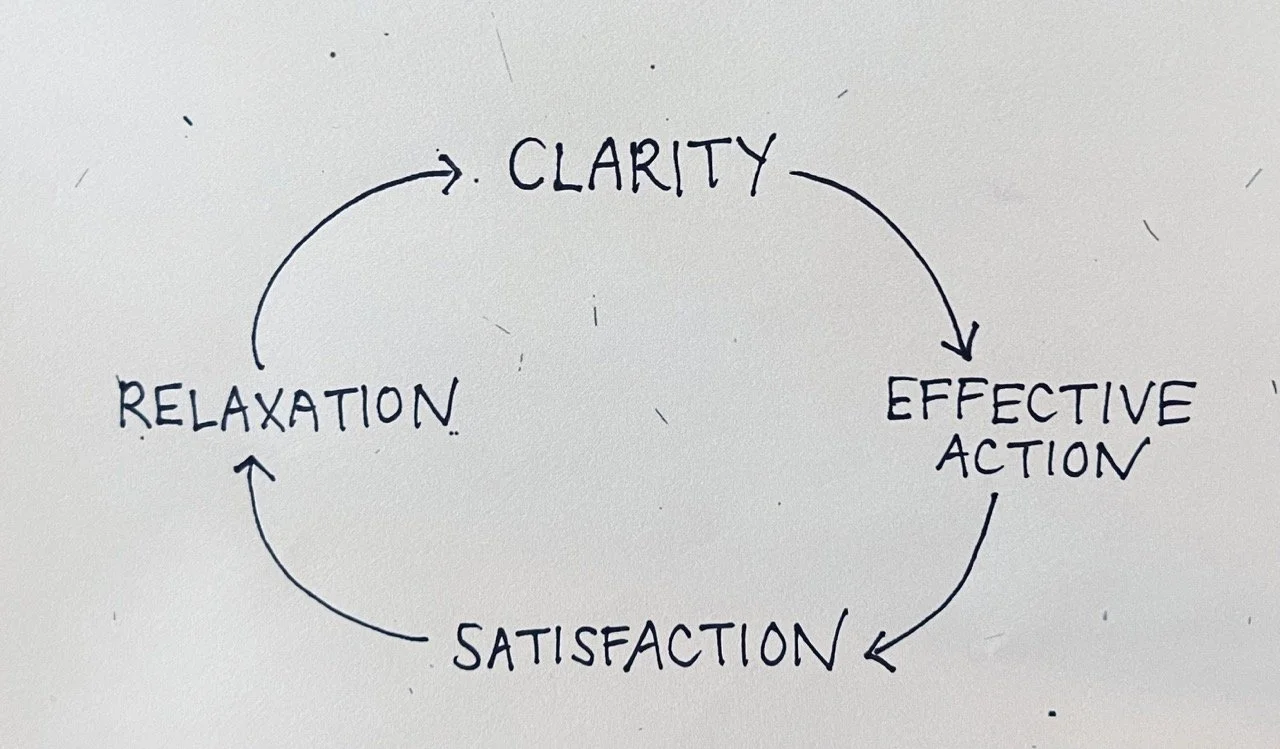
This cycle engages both the sympathetic and parasympathetic nervous systems. Our sympathetic nervous system allows us to mobilize for action; it brings alertness and energy. The parasympathetic system allows us to relax and regenerate our energy. If there is an imbalance or a barrier in place, it can be difficult to complete the full cycle. We can get stuck in any stage. These stages have a direct impact on where we hold tension in our bodies.
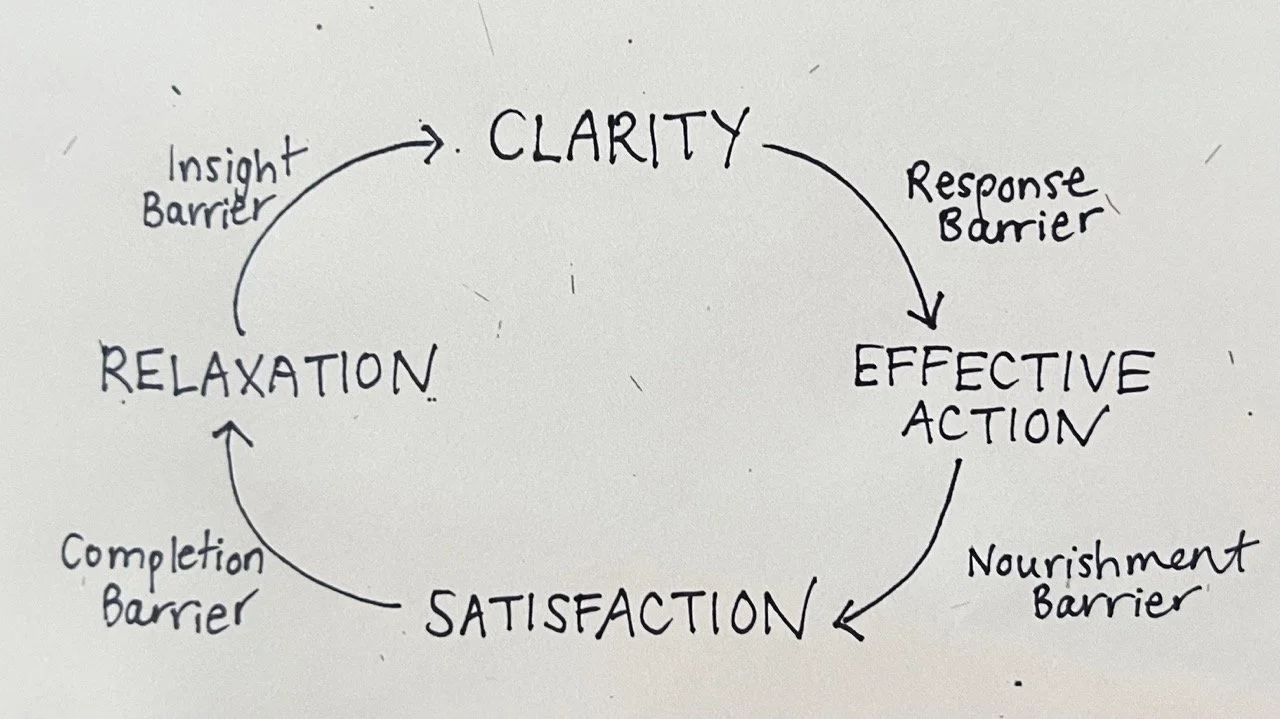
Insight barriers block the clarity needed to take effective action. At its core, the insight barrier is protection from feeling. Somatically, this can manifest as a lack of sensation in the body. There will be a disconnection from sensate experience often in favor or being overly intellectual or analytical. On the other hand, insight barriers may occur from not allowing full relaxation to show up in our lives, which invites creative thinking and possibility.
Response barriers block effective action to attain what is needed. This could be embodied in different ways, from fear of taking risks or accepting responsibility for ourselves or our choices. Or maybe our response itself needs reassessment; is how we're thinking about or taking action on our problems working? Are we building the right container with our thoughts and actions, for the outcome we want?
Nourishment barriers block the experience of satisfaction when what you want has been fulfilled. Those who are stuck in nourishment barriers tend to fear developments and experiences that feel good, like letting in love or taking in compliments. Sometimes experiences will not be enjoyed or allowed in fully, because we feel they are not good enough, or we fear they will not last or will be taken away, which creates pain.
Completion barriers block relaxation, which supports the savoring of the need that's been attained and the releasing of tension. Those who feel like their worth is measured in their achievements tend to be stuck in the completion barrier. People will often feel like: “I’m not worthy unless I...."
Despite the challenges that come with them, these barriers serve an important and natural function. They exist in all of us, yet one or a few may be more dominant in our lives. Nonetheless, these barriers were formed to protect us from painful and overwhelming aspects of our early lives when we were the most vulnerable.
These barriers can continue, to some extent, to keep our boundaries, dignity, and vulnerability safe from invasion, manipulation and exploitation. But they can also hold us back and keep us from being in deeper contact with our own experience, in turn keeping us from having the capability of deeper connections with others. They can keep us from being nourished by our environment. They can keep us from appropriately and skillfully responding to life’s various experiences. They can also keep us from letting go of the past and staying in the present moment. And perhaps most importantly, they can keep us locked in an unconscious patterned way of being in the world that limits our conscious decision-making. Insight and contact with reality becomes wisdom and meaning. Action and mobilization becomes competence, and then eventual mastery. Satisfaction and enjoyment builds fulfillment and joy. Rest and integration builds trust of vulnerability and surrender.
— Hakomi psychotherapist Dan Michels

Corona Arch in Moab, Utah
Wonder, experiment, openness. These promote change. Habit, the trance of ordinary consciousness, the intense pursuit of narrow goals, these destroy our natural potential for healthy reorganization. Narrow attention and rapid action are quite necessary, at times, when it is important that we reach some goal without disruption. Think of a rushing to the hospital with a woman in labor. No time there for quietly studying one's subtle reactions. Just keep your mind on the job and get safely through the traffic. Yes! For that kind of thing, speed and focused attention are just the ticket. For studying the self, it won't work. For studying the self, the time needs eyes that need not watch the road.
— Ron Kurtz, founder of Hakomi
In psychophysics, there's a law called the Weber-Fechner Law. It states that the level of signal you can detect is dependent on the background noise. If the background noise is too loud, you can't hear the signal. This tells us something about getting in touch with ourselves. It also reveals a lot about our culture, and all the noise that numbs us to our own sensitivity, our ability to see things clearly, and listen deeply to ourselves and to each other.
Yet we don't need to instill force or fix ourselves; we just need to turn down the noise. As the noise goes down, the signal emerges. Hakomi works to lower the noise rather than raise the signal.
The concepts and teachings behind Hakomi are profound to me. They've made a significantly meaningful impact on the troubled youth I've worked with over the years. They've helped me expand my own awareness of the full range of my humanity. They've also helped me let go of the rigidity behind my attachments, realizing that I didn't necessarily need to change, as much as get out of my own way. As Carl Jung says, people don't get cured; they simply move on.
This is the basis of the sensitivity cycle: we become more aware of the many different ways we can do things. Naturally, out of survival value, we automatically select the more effective, efficient, and pleasurable ways. We get better at what we're doing as a result. Kurtz states that "mastery is the natural result of mindfulness." Effective action and awareness compliment each other. We build new and easier ways to move, a new body-image, more pleasure, more aliveness. And with this comes a new image of the self.
At some point in this process, we reach a level of sensitivity where experience becomes intense and emotional. Until one is clear and balanced, this emergence of emotional material will have to happen. The only way to avoid it is to either stay tense, and therefore insensitive, or to look somewhere else, to shift your awareness to something else. We all use those two broad strategies to mask experience. Those mechanisms are our defenses. We're either focused on something else, tuned to a different station as it were, which pushes the pain or whatever into a shadowy background, or we're doing something very noisy, numbing our bodies and minds. The barriers to sensitivity are noise and distraction. In order to reach beliefs, memories, and feelings at a level of experience difficult to tolerate, the [healer] simply helps the [person] become more sensitive. Of course one can be relaxed without processing anything, but not if you freely allow experiences to emerge and you stay with them.
High sensitivity and an openness to experience lead quite naturally to the emotional and spiritual growing we have left to do.— Ron Kurtz
Hakomi is the process of creating the right container for these emotional releases to occur, which can be significantly intense and chaotic. It will look different for each of us, depending on our unique lived experiences. Through various Hakomi processes, I've been able to come into direct contact with my deepest fears and wounds. To experience what it's like to be in the actual pain of them, to become the pain itself, to see the images and feelings and memories deeply associated with them without pushing them away.
What a profound and subtle experience it is to shift into the authentic embodiment of our stuck points. To let go of all the walls and armor (for me, this shows up as either anger/rage or putting a positive spin on the experience) and to allow myself to make whatever sounds, words, and actions come from this untamed place. Yet this place, when experienced most authentically, is usually not a dramatic or performative space. It is a real, gritty, raw, deeply vulnerable experience. In the presence of loving and compassionate support from ourselves and those around us, these experiences can be possible. And they can transform us.